AI will not replace recruiters.
But the recruiter sitting next to you who has figured out how to use AI to shortlist faster, engage better, and make stronger decisions, will outperform you by a ratio that makes your position hard to justify. That is the real threat. Not the machine. The colleague with better tools.
This is not a prediction. It is already happening.
What the data says
LinkedIn’s 2026 Talent Trends report found that 62% of talent acquisition leaders are now actively piloting AI tools inside their hiring workflows, up from 27% in 2024. The adoption curve is not gradual. It is steep.
The World Economic Forum’s Future of Jobs report projects that AI will augment 85 million roles globally by 2027, with recruiting and HR cited as one of the functions where human-AI collaboration produces the greatest productivity gains, not displacement.
The pattern is consistent across industries: the professionals who embrace AI as a working layer do not get replaced. They become significantly more productive than those who do not, and that gap in output becomes a gap in value, which eventually becomes a gap in employment.
Recruiting is no exception.
What AI cannot replace in a recruiter
The irreplaceable part of recruiting is human judgment at the moments that matter.
A candidate who looks average on paper but has the trajectory, drive, and cultural fit to become a top performer. A hiring manager whose real requirements are different from what the job description says. A finalist who is being courted by two other companies and needs a conversation, not an email sequence, to stay engaged.
No AI system reads that room. No algorithm builds the trust that moves a candidate from interested to committed. No shortlisting tool replaces the recruiter who asks the right question on a call and changes the outcome of a hire.
These are the moments that define a great recruiter. And they are exactly the moments that get buried under 200 unreviewed resumes, five overdue follow-ups, and a calendar full of coordination tasks that a system should be handling.
What is actually shifting
The recruiter’s job is not disappearing. The definition of what a good recruiter spends their time on is changing, fast.
In 2022, spending three days screening resumes for one role was unavoidable. In 2026, it is a choice.
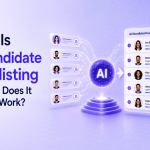
AI candidate shortlisting processes every application against the actual requirements of the role, skill depth, experience quality, career trajectory, and surfaces the strongest candidates in hours, not days. The recruiter who still does this manually is not more thorough. They are slower, and their shortlists are less consistent.
The same shift is happening in scheduling, follow-up, pipeline tracking, and job description writing. The tasks that consumed 60% of a recruiter’s week can now be handled by an agentic hiring platform that works autonomously across the hiring lifecycle.
What remains, and what compounds in value, is the 40% that only a recruiter can do.
Sanju L, Global Head of Talent Acquisition at Zycus, put it directly: the previous tool claimed to use AI, but in practice, it was still manual work with a better interface. The shift to Talismatic meant the team’s time moved from screening to closing, and hiring velocity improved by 85%.
What “using AI” actually looks like
Using AI in recruiting does not mean handing the process to a machine and reviewing its output. It means building a working layer that removes the low-judgment work so you can do more of the high-judgment work.
In practice, for a TA leader at a mid-market tech company, it looks like this:
A role opens. The AI evaluates every application as it arrives, ranks candidates by genuine fit, and flags the top ten with clear reasoning. The recruiter reviews those ten, not two hundred. They make calls. They build relationships. They close.
The coordination, the follow-up, the rediscovery of past candidates for similar roles, the agentic layer handles it. The recruiter’s fingerprint is on the decisions, not the administration.
That is not a recruiter being replaced. That is a recruiter operating at a level that was not possible three years ago.
The choice is not AI vs recruiter
It is AI-augmented recruiter vs manually-constrained recruiter.
One can shortlist a role in four hours and make ten meaningful candidate calls in a day. The other spends three days reviewing resumes and reaches candidates who have already moved on.
The organisations hiring right now are noticing the difference. The TA leaders building AI into their workflows are delivering faster, better, and with less team strain. The ones waiting to see how it plays out are watching their time-to-hire creep up and their best candidates go elsewhere.
The window to be the recruiter who uses AI, before it becomes table stakes, is open right now. It will not stay open long.
See how Talismatic helps TA teams move from screening to closing. Book a 20-minute demo →
AI will not replace recruiters, but it will fundamentally change what recruiters spend their time on. The tasks that consume the majority of a recruiter’s week, resume screening, scheduling, and follow-up, are increasingly handled by AI systems. Recruiters who adapt spend more time on judgment-dependent work: candidate relationships, hiring manager alignment, and closing. Those who do not adapt become slower and less competitive than their peers who do.
The most impactful AI tools for recruiters in 2026 focus on candidate shortlisting, pipeline intelligence, and conversational hiring. Platforms like Talismatic combine agentic, contextual, and conversational AI to handle screening and coordination autonomously, so recruiters spend their time on the work that requires human judgment.
AI improves recruiter productivity by removing the low-judgment, high-volume tasks from the recruiter’s workflow. AI candidate shortlisting reduces time-to-shortlist by up to 85%. Automated follow-up and scheduling eliminates coordination overhead. Pipeline intelligence surfaces risks and priorities without manual tracking. The result is a recruiter who handles more roles, at higher quality, with less administrative strain.
The recruiter skills that compound in value as AI handles more operational work are: candidate relationship-building, hiring manager influence, market intelligence, and offer negotiation. These are judgment-dependent skills that AI augments but cannot replace. Recruiters who invest in these capabilities while delegating operational tasks to AI will be the most valuable in their organisations.
- Your Career Site Is More Than a Hiring Tool. It’s a Reflection of Your Brand
- AI Is Reducing the Number of People Companies Need. So How Do You Make Every Hire Count?
- Not Every Application Means Interest: The Hiring Signal Recruiters Are Missing
- Empowering Recruiters With AI: How to Prepare Them for the Next Era of Hiring
- When Every Candidate Uses AI, How Does TalentAI Find the Signal That Still Matters?