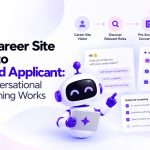
A candidate visits a company’s career site and asks, “I have five years of marketing experience and prefer hybrid work. Which roles would suit me, and how do I apply?”
A basic scripted chatbot may require the candidate to navigate separate menus for job listings, work arrangements, and application instructions. A more capable AI chatbot can interpret the question, use relevant information, and generate a response that addresses the candidate’s specific needs.
The difference goes beyond how naturally a chatbot speaks. It lies in how the system interprets requests, coordinates tasks, accesses information, and determines the next response. This is where AI agent orchestration becomes relevant.
What Is AI Agent Orchestration?
AI agent orchestration is the process of coordinating AI capabilities, information sources, tools, and workflows to complete a task. Rather than treating every message as an isolated question, an orchestrated system can determine what a user is asking, identify the steps needed, and coordinate the work required to respond.
According to OpenAI’s practical guide to building AI agents, agents can use language models to manage workflows, select tools, and execute tasks within defined guardrails.
Not every orchestrated system requires multiple autonomous agents. Some use a single AI model with access to specific tools, while others coordinate specialised agents for different tasks. The right approach depends on the complexity of the problem. The essential principle is that the system coordinates how a task is handled, rather than relying exclusively on a fixed sequence of scripted interactions.
How Does Orchestration Work in an AI Chatbot?
Consider a candidate who wants to understand their suitability for a position and find out how to apply. Handling this request may involve several connected steps.
First, the AI interprets the candidate’s intent. It identifies that the question concerns experience, job suitability, and application guidance, even though the candidate has expressed these needs in a single sentence.
Next, the system retrieves relevant information from available sources, such as job descriptions, eligibility requirements, company information, and application instructions. The information must be relevant and current for the response to be useful.
The AI then generates a response based on that context. Depending on the system’s capabilities, it may identify potentially relevant vacancies, explain role requirements, or direct the candidate towards the appropriate application process.
Finally, the chatbot determines the appropriate next step in the conversation. It might answer a follow-up question, offer further job details, or acknowledge that the requested information is unavailable.
These activities may happen within one model-driven workflow or across several coordinated components. Microsoft’s documentation on AI agent orchestration patterns describes approaches such as sequential execution, parallel processing, and task handoffs. The goal is not to introduce complexity for its own sake. It is to handle requests that require more than retrieving a single predetermined answer.
Why Move Beyond Fixed Responses?
Scripted chatbots have a legitimate purpose. They can handle predictable questions, direct users through standard procedures, and provide consistent answers when the conversation follows an expected path. Their limitations become more apparent when users phrase questions differently, combine multiple requests, or ask for information that depends on context. A rigid conversation flow may force users to select from predefined options even when their intent is clear.
AI-driven conversations offer a different approach. Instead of requiring every question to match a predefined phrase, the system can interpret natural language and generate a response suited to the context. For recruitment, this matters because candidates rarely approach a career site with identical questions. One may want to understand eligibility, another may be comparing two roles, and a third may need clarification about the application process.
The value is not simply having more possible responses. It is making the interaction more relevant to what each candidate is trying to accomplish.
This distinction should be made carefully: modern chatbots can also use generative AI, so orchestration alone does not automatically make one product more capable than another. The relevant questions are how the system uses context, coordinates tasks, retrieves reliable information, and handles requests it cannot resolve.
How TalentBot Applies This to Career-Site Conversations
TalentBot by Talismatic brings conversational AI to the employer’s career site, helping candidates ask questions, explore vacancies, and receive guidance before applying.
Its intended distinction from a purely scripted FAQ experience is that candidates are not limited to selecting predefined questions and receiving one fixed response for each. TalentBot is designed to interpret naturally phrased questions and generate relevant responses using available company and job information.
For example, a candidate might ask which roles align with their experience before requesting more information about one of the recommendations. The interaction can develop according to what the candidate asks next, rather than requiring them to restart the conversation through a separate menu for every question.
This creates a more flexible way to explore job opportunities and understand the application process. It can also reduce the need for candidates to search across multiple pages for basic information, while helping recruiters spend less time addressing repetitive queries.
Learn more about TalentBot’s AI recruitment chatbot for career sites or read about conversational hiring and how it works.
Why Orchestration Still Needs Guardrails
Generating responses dynamically does not guarantee accuracy. A chatbot can misunderstand intent, rely on outdated information, or produce an answer that sounds convincing without being adequately supported. Reliable implementations therefore need approved information sources, clearly defined operating boundaries, appropriate handling of uncertainty, and testing against realistic user questions. They also need a way to direct candidates to human support when a request cannot be resolved appropriately.
The quality of the experience depends on both flexibility and control. The system must be able to interpret varied requests without inventing job details, eligibility requirements, or recruitment policies.
These considerations are particularly important in hiring, where inaccurate information can mislead candidates and create unnecessary work for recruitment teams.
What This Means for the Future of Recruiting Chatbots
AI agent orchestration represents a shift from managing conversations through predetermined paths towards coordinating tasks around a user’s intent. In recruitment, that creates opportunities to make job discovery, candidate questions, and application guidance feel like parts of one connected experience. For employers, the important consideration is not how many agents a chatbot contains or how advanced its architecture sounds. It is whether the system can provide relevant information, handle varied questions, guide candidates towards useful next steps, and operate reliably within defined boundaries.
The next generation of recruiting chatbots will be distinguished not simply by their ability to generate text, but by how effectively they turn a candidate’s question into a useful outcome.
AI agent orchestration coordinates AI models, information sources, tools, and workflows so a chatbot can interpret a request and complete the steps needed to respond. Depending on the design, orchestration may use a single AI agent or multiple specialised agents.
A rule-based chatbot follows predefined conversation paths and responses. An AI chatbot can interpret natural-language questions and generate contextual answers. Some products combine both approaches to balance flexibility, consistency, and control.
No. A single AI agent connected to suitable tools and information sources can coordinate a workflow. Multiple agents may be useful when tasks require specialised capabilities, but they also introduce additional complexity.
It can help coordinate candidate questions, job information retrieval, role recommendations, and application guidance within a connected interaction. The actual benefits depend on the chatbot’s capabilities, the accuracy of its information, and how well the workflow is implemented.