You did not start a company to become a recruiter.
But somewhere between closing your funding round and hitting product-market fit, hiring became the thing consuming every spare hour. You are screening resumes at midnight. You are rescheduling interviews because your calendar has no space. You are losing candidates to companies with full TA teams who move three times faster than you.
And you still need to hire 10 people in the next 90 days.
Here is the practical guide nobody gave you, a six-step hiring process built for founders who are doing five other things at once.
Why Hiring Feels Different When You Are the Founder
When a recruiter screens resumes, it is their job. When you do it, it is stealing time from product, customers, investors, and the hundred other things that only you can handle.
The real problem is not that hiring is hard. It is that founder-led hiring has no process behind it. Every role starts from scratch. Every interview is improvised. Every offer takes a week to get approved because it lives in your head, not in a system.
According to ManpowerGroup’s 2026 Talent Shortage Survey, 82% of Indian employers report difficulty filling roles, and early-stage startups feel this harder than anyone, because they cannot offer the brand recognition or compensation certainty of a larger company.
The answer is not hiring a TA team you cannot afford yet. It is building a process that works without one.
The 6 – Step Hiring Process for Founders
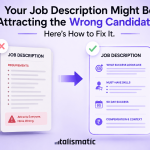
Step 1 – Write a job brief, not a job description
A job description lists everything you want. A job brief defines the one or two things that actually determine whether this hire succeeds or fails in the first 90 days.
Before posting any role, answer three questions: What does this person need to accomplish in the first 90 days? What does a strong candidate look like, specifically, not generically? What would make you say “this was a bad hire” six months from now?
Write those answers down. They become your screening criteria. Everything else is noise.
Step 2 – Source from your network before going to job boards
Your warm network is faster, cheaper, and higher-signal than any job board. A referral from someone who knows your company and the candidate’s work quality is worth 20 cold applications.
Before posting publicly, send a specific message to 10-15 people in your network. Not “let me know if you know anyone”, that produces nothing. Be specific: “I am hiring a senior backend engineer who has built at scale in a product startup. Do you know anyone who fits this?” A specific ask gets a specific response.
Post externally only after your network search is exhausted. When you do post, LinkedIn and Naukri for India-facing roles. Do not spray across every job board, you will just create more applications to screen.
Step 3 – Use AI to screen. Do not do it manually.
This is where most founders lose weeks.
Manually reviewing 80 applications for a single role takes 6-8 hours of genuine attention. At 5 open roles, that is 30-40 hours, nearly a full work week, before a single conversation has happened.
AI candidate shortlisting evaluates every application against your brief, ranks candidates by actual fit, skills depth, experience relevance, career trajectory, and surfaces the top 8-10 worth speaking to. What takes you 30 hours takes the system 4.
The output is a ranked shortlist with reasoning, not a pile to wade through. You start your week calling candidates, not reading resumes.
Step 4 – Run a two-stage interview. No more.
Three-stage, four-stage, panel-plus-assignment processes exist to protect large companies from bad hires at scale. They are wrong for an early-stage startup.
A two-stage process works:
Stage 1 – 30-minute conversation. You or a senior team member. Assess motivation, communication, and whether this person understands what they are walking into. Most candidates drop out here naturally.
Stage 2 – 60-minute working interview. Give them a real problem you are facing. See how they think, not how they perform under rehearsed conditions.
That is it. Two stages. Both stages scheduled in the same week. Any longer and you will lose the candidate you most want to hire.
Step 5 – Decide in 48 hours
The most common reason founders lose strong candidates is not compensation, it is speed.
A candidate who finishes Stage 2 on Thursday and hears nothing by the following Wednesday has already mentally moved on. Set a rule: any candidate who completes the final stage gets a decision within 48 hours. Either an offer or a clear, honest no.
This discipline does two things. It forces you to be decisive rather than endlessly deliberating. And it signals to candidates that your company moves, which is exactly the kind of environment strong early hires want to join.
Step 6 – Make onboarding a process before the first hire starts
Most startups wing onboarding. The new hire arrives, gets handed a laptop, and figures out the rest as they go. Three months later you are wondering why they are not performing.
Before your first hire joins, write down three things: what they should know by end of week one, what they should be doing independently by end of month one, and who they need a relationship with to be effective. That document takes two hours to write and saves months of misalignment.
How AI Makes This Possible Without a TA Team
The six steps above are not theoretical. They become practical when you have an AI hiring layer handling what would otherwise require a dedicated recruiter.
Talismatic is built specifically for teams that do not have the luxury of a full TA function. Founders and first HR hires use it to shortlist roles in hours instead of days, engage candidates automatically between stages so nobody goes cold, and run the entire process from a single interface without building a tech stack.
Amit D, Founder at OdessyCloud, used to handle hiring entirely himself, every resume, every scheduling email, every follow-up. Hiring was the thing that slowed his team’s growth down most. After switching to Talismatic, the AI handled screening and coordination. Amit’s time went back to the business.
That is the version of founder-led hiring that scales. Not working harder, having a system that works while you do everything else.
Hire your first 10 people without it consuming your life. See how Talismatic works for startups →
- Your Career Site Is More Than a Hiring Tool. It’s a Reflection of Your Brand
- AI Is Reducing the Number of People Companies Need. So How Do You Make Every Hire Count?
Hiring your first employees without an HR team requires a simple, repeatable process rather than a full talent acquisition function. Write a specific job brief defining what success looks like in the first 90 days. Source from your warm network before posting publicly. Use AI candidate shortlisting to screen applications so you are not manually reviewing every resume. Run a two-stage interview process and make decisions within 48 hours of the final stage. The goal is speed and signal quality, not process complexity.
Most startups benefit from a dedicated HR or talent person when they are hiring more than 5-8 people per quarter and the founder is spending more than 20% of their week on recruiting. Before that threshold, a structured founder-led process with AI support can handle the load without the overhead of a full-time hire. The trigger is not headcount — it is the point where hiring complexity starts consistently pulling the founder away from the work only they can do.
An effective early-stage hiring process should take 10-14 days from application to offer for most roles. Two interview stages, both scheduled in the same week, with a decision made within 48 hours of the final stage. Longer processes lose strong candidates to faster-moving companies. Shorter processes — skipping one of the stages — increase the risk of a bad hire. Ten to fourteen days is the window where speed and diligence are both achievable.
The biggest hiring mistake founders make is starting every role from scratch with no defined process. Without a clear job brief, screening criteria, or structured interview format, every hire becomes an improvised project that takes weeks longer than it should and produces inconsistent results. The second most common mistake is moving too slowly at the offer stage — waiting more than 48-72 hours after a final interview to make a decision, by which point the strongest candidates have already accepted other offers.