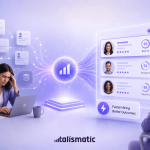
Picture a recruiter on a Monday morning. Twelve open roles. 340 unreviewed applications. Three hiring managers chasing shortlists. Two candidates went cold over the weekend.
The ATS is fully updated. Every stage is tracked. Every email is logged.
And yet the recruiter is still the one who has to figure out what to do next.
This is the ceiling of traditional hiring automation, and it is why agentic AI in HR is becoming one of the most important shifts in talent acquisition right now.
Why automation alone was never enough
For the past decade, HR technology has sold efficiency. Automated emails. Workflow triggers. Stage-based pipelines. Application tracking at scale.
It worked, to a point.
The problem is that automation is reactive. It waits for a recruiter to act, then responds. It does not understand context. It cannot tell you which candidate to call first, where your pipeline is about to break, or why you keep losing candidates between the screen and the panel interview.
So even with a fully implemented ATS, recruiters still carry the full cognitive load of hiring. They search, evaluate, prioritise, coordinate, follow up, and make decisions across dozens of open roles simultaneously.
As hiring volumes grow and candidate expectations accelerate, that model does not scale.
What agentic AI in HR actually means
Agentic AI is not a smarter version of automation. It is a fundamentally different category.
Where traditional tools execute instructions, agentic systems work toward outcomes. They understand the goal, finding the best candidate for this role, as fast as possible, and take initiative to get there.
In practice, this means an agentic hiring platform can:
- Surface the top candidates from 300 applications without a recruiter filtering manually
- Identify where pipeline delays are happening before candidates go cold
- Rediscover qualified candidates from previous roles when a similar position opens
- Recommend the next best action at every stage of the process
- Explain its recommendations, not just give a score, but show the reasoning
That last point matters more than most people realise. Recruiters do not want a black box that ranks candidates and asks them to trust it. They want a system that says: candidate A ranks above candidate B because of X, Y and Z. That transparency is what builds confidence, and what gets hiring managers to actually trust the shortlists they receive.
The rise of AI hiring agents
Inside modern agentic hiring platforms, the intelligence is often delivered through specialised AI hiring agents, each focused on a distinct part of the hiring lifecycle.
Some handle candidate screening and scoring. Others manage interview coordination, follow-up communication, or pipeline risk detection. Together, they cover the operational layer of recruiting, the work that consumes hours of a recruiter’s week without requiring a recruiter’s judgment.
The result is not that recruiters do less. It is that they do different work. Less time in spreadsheets and ATS dashboards. More time in conversations with candidates, building relationships with hiring managers, and making the high-judgment calls that actually determine hiring quality.
For a recruiter managing 15 open roles at a 400-person SaaS company, that shift is the difference between surface-level screening and genuinely strong shortlists.
Conversational AI changes how recruiters work
One of the most visible changes agentic platforms bring is how recruiters interact with hiring data.
Instead of navigating dashboards, applying filters, and pulling reports, recruiters can ask questions in plain English:
“Who are the top five Java developers for this role?” “Which candidates applied in the last 30 days and match our last three hires?” “Where are we losing candidates in the funnel this month?”
The system answers, with reasoning, not just results.
This is what conversational AI in recruiting looks like in practice. It removes the friction between a recruiter’s question and the insight they need, which means faster decisions and fewer candidates falling through the cracks while the team is still deliberating.
From tracking to thinking, the shift happening right now
The most useful way to understand the agentic shift is this:
A traditional ATS answers the question: where is this candidate right now?
An agentic hiring platform answers the question: which candidates should I prioritise, why, and what should I do next?
That distinction is what separates process management from hiring intelligence.
Teams making the switch are not doing so because their current ATS stopped working. They are doing so because the gap between what their recruiters can manage manually and what the business needs them to deliver keeps widening.
Hiring 30 people in a quarter without an agentic layer means burning out your TA team. With one, it means your recruiters spend their time closing candidates instead of managing logistics.
How Talismatic is built for this shift
Talismatic was built from the ground up as an agentic hiring platform, not an ATS with AI added later.
The difference shows up in how recruiters actually use it. They do not log in to update stages and run reports. They ask Talismatic which candidates to focus on, get a ranked shortlist with clear reasoning, and move. The coordination, the follow-up, the rediscovery of past applicants, the platform handles it.
The outcome is concrete: 85% faster shortlisting. 60+ recruiter hours saved per hiring cycle. Hiring managers who trust the profiles they receive because they can see why each candidate made the cut.
As Sanju L, Global Head of TA at Zycus, put it, the previous tool was supposed to use AI, but in practice it was still manual screening. Talismatic was built different.
That is the gap agentic AI closes.
What this means for your team
If you are a TA leader managing growing hiring volumes with the same headcount, or a founder trying to make 20 hires without a full recruiting team, the promise of agentic AI is straightforward:
Stop managing the process. Start driving the outcome.
The recruiter’s job does not disappear, it gets better. Less administration, more judgment. Less pipeline maintenance, more candidate relationships. Less reacting to what went wrong, more preventing it.
That is what agentic AI in HR makes possible.
Ready to see it in practice? Book a 20-minute demo with Talismatic →