For most enterprises, hiring is still driven by one core system: the applicant tracking system.
It brings structure to recruitment. It centralizes applications, standardizes workflows, and makes it easier to manage hiring at scale.
And yet, despite all of that, one problem hasn’t gone away.
Hiring still takes too long.
Roles stay open for weeks or months. Recruiters spend hours screening candidates. Hiring managers wait for shortlists. And decisions move slower than they should.
The question is no longer whether you have the right tools.
It’s finding out why hiring is still slow, even with them in place.
Expectation vs. The Reality of ATS
When organizations invest in an applicant tracking system, the expectation is clear: faster, more efficient hiring.
And to some extent, that’s true.
An ATS organizes a hiring process. It centralizes candidate data, standardizes hiring workflows, ensures compliance, and gives teams visibility into every stage of the process. It also helps coordinate across recruiters and hiring managers, making large-scale hiring more manageable.
But speed is not just about managing workflows.
It’s about improving the final outcome and decisions.
And this is where the gap begins.
Because while an ATS helps track and manage what’s happening, but it doesn’t always help teams decide what should happen next.
Where the Hiring Process Slows Down
If you look closely, hiring delays rarely come from one single issue. They build up across multiple stages.
- Manual Screening Bottlenecks: Recruiters still spend a significant amount of time reviewing resumes. Even with filters and keyword searches, most decisions require manual validation. In high-volume scenarios, this leads to surface-level screening and slower shortlisting.
- Inconsistent Evaluation: Different recruiters and hiring managers interpret profiles differently. Without structured evaluation frameworks, decisions vary, leading to rework, misalignment, and delays in moving candidates forward.
- Poor Candidate Prioritization: Not all applicants are equal, but most systems don’t actively prioritize them. Recruiters often have to decide where to focus their time, which means strong candidates can sit in the pipeline longer than they should.
- Pipeline Visibility Gaps: While ATS platforms show where candidates are, they don’t always show pipeline quality. Teams can track progress, but they struggle to understand whether they’re moving the right candidates forward.
- Delayed/Uninformed Decision-Making: Hiring decisions often require multiple stakeholders. Without clear insights and structured recommendations, these decisions take longer, slowing down the entire process. In some cases, decisions are made without proper contextual understanding of the candidate and the job.
Why Automation Alone Doesn’t Solve the Problem
To address these challenges, many organizations have invested in recruitment automation.
Automation helps streamline repetitive tasks, trigger workflows, and improve operational efficiency. But it doesn’t fundamentally change how hiring decisions are made.Automation moves candidates faster through the system. It doesn’t ensure the right candidates are being moved forward.
And that distinction matters. Because speed without accuracy often leads to rework, longer hiring cycles, and weaker outcomes.
The Real Problem: A Lack of Decision Intelligence
At its core, slow hiring isn’t just an operational issue.
It’s a decision problem.
Recruiters are constantly making choices:
- Which candidates to prioritize
- Who to move forward
- When to take action
When these decisions rely on manual effort and fragmented information, they take time.
This brings in uninformed decisions and guesswork, while slowing the entire process down.
This is where traditional systems fall short.
They manage the process, but they don’t actively improve the quality or speed of decisions within it.
How AI Changes the Equation
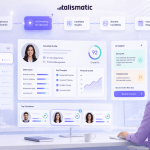
AI introduces a different approach to hiring. In AI-enabled ATSs like Talismatic, decision-making is improved at every stage while also focusing on workflows.
With AI, systems can:
- Analyze candidate data beyond keywords
- Identify patterns in experience, skills, and progression
- Rank candidates based on role fit
- Provide clear reasoning behind recommendations
This is where true hiring process optimization begins.
Recruiters no longer have to do guesswork, improving the quality of hires.
They work with insights that are already structured and prioritized.
What Smarter Hiring Actually Looks Like
When intelligence is introduced into the hiring process, the impact becomes clear.
Faster Shortlisting: AI scans for signals, skills, and shortlists candidates that are a better fit for the role, reducing time spent on initial screening.
More Consistent Decisions: Structured evaluation frameworks reduce variability across recruiters and hiring managers.
Reduced Back-and-Forth: Clear recommendations and insights help stakeholders align faster.
Better Pipeline Quality: Teams focus on the most relevant candidates earlier in the process.
Shorter Time-to-Fill: With fewer delays and better prioritization, roles get filled faster.
Moving From Workflow Management to Decision Acceleration
The role of hiring technology is evolving. The applicant tracking system remains essential as the system of record. But on its own, it is not enough to deliver faster hiring.
What organizations need is a layer that sits atop the ATS and enhances it.
One that turns data into insights.
And insights into action.
This is the shift from workflow management to decision acceleration.
Closing the Gap with AI-Powered Hiring
This is where platforms like Talismatic come in.
By integrating agentic and conversational AI, Talismatic becomes an AI Recruitment Co-Pilot, transforming how hiring decisions are made.
Instead of relying on manual screening and fragmented insights, recruiters get:
- AI-driven candidate prioritization
- Consistent evaluation across roles
- Clear recommendations with context and reasoning
- Faster, more confident decision-making
It doesn’t replace your ATS.
It makes it smarter.
And that’s what ultimately reduces hiring time, not just by speeding up tasks, but by improving the quality and speed of decisions.
Conclusion: Faster Hiring Starts with Better Decisions
Hiring doesn’t slow down because of a lack of tools. It slows down because of how decisions are made within those tools.
The applicant tracking system solved for structure.
Recruitment automation improved efficiency.
But real progress comes from better decisions. Because when decisions become faster, clearer, and more consistent, everything else follows.
If you’re still experiencing delays despite having an ATS, it may not be a process issue. It may be a decision gap. And that’s exactly where AI makes the difference.
If you want to see how faster, intelligence-driven hiring works in practice, book a FREE demo with Talismatic and experience it firsthand.